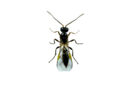
Amphimallon spp. Chafers General The chafers are beetles of the Scarabaeidae family. The larvae of both species live in the soil and feed on the roots of many plants. They are a serious pest that can
prothoracic shield, later they become earth-brown to dingy grey. They are about 1.5 mm long just after emergence and can reach 4 cm or more when fully grown. The
yellowish brown or light brown with a darker head. Larval development takes 4 to 5 years. When fully grown the larvae pupate in the soil in summer. The adults
Clepsis spectrana Cabbage leafroller General The cabbage leafroller (Clepsis spectrana) is native to North-West Europe. It is a highly polyphagous species causing damage to field grown cabbage, apple,
damp soil, where they also pupate. The adult shore fly is black, about 4 to 5 mm long, and stout with short antennae and short legs. The head of the adult
Chrysodeixis chalcites Tomato looper General The golden twin-spot moth or tomato looper ( Chrysodeixis chalcites ) belongs to the family of Noctuidae . It is a tropical and subtropical species origina
Phytonemus pallidus Cyclamen mite General The cyclamen mite ( Phytonemus pallidus ) is a harmful strawberry pest as well as a common pest found in cyclamen, gerbera and other ornamentals. Mites belong
Thrips tabaci Onion thrips General The onion thrips (Thrips tabaci) is distributed throughout the world. It is found outdoors on many plants and particularly damaging on onions, leek, and in greenhous
Aculops lycopersici Tomato russet mite General The tomato russet mite (Aculops lycopersici , also referred to as Vasates lycopersici, Vasates destructor and Phyllocoptes destructor in older publicatio
Spodoptera exigua Beet armyworm General The beet armyworm (Spodoptera exigua) has become a regular problem for horticulturalists due to its resistance to nearly all insecticides, and its ability to de