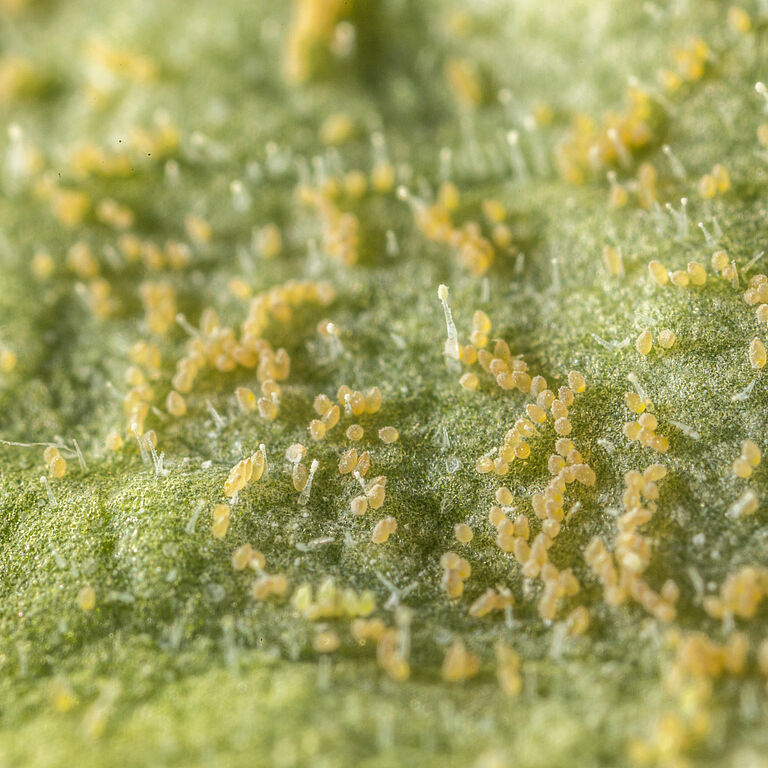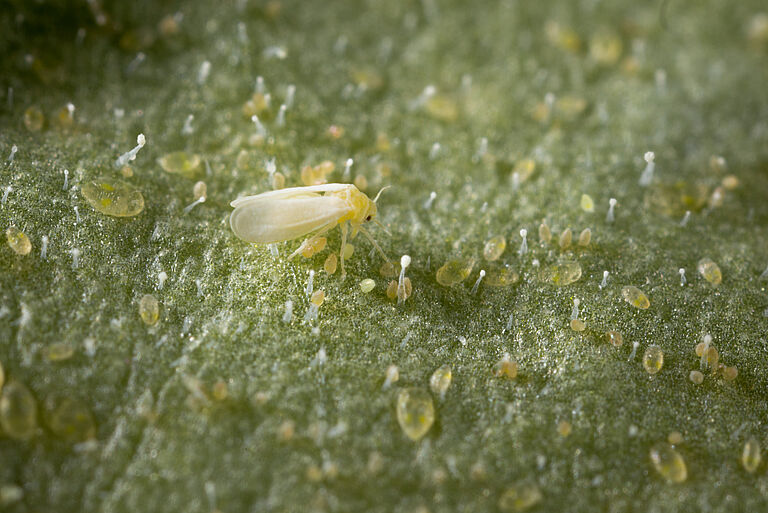

Life cycle and appearance of Tobacco whitefly
The tobacco whitefly (Bemisia tabaci) goes through six stages, namely egg, first, second, third and fourth larval stage (often referred to as ‘pupa’ although strictly spoken this is not true) and adult. The larvae are found on the underside of young leaves and have an oval shape. The first instar larvae (crawlers) are mobile, whereas the rest of the larvae stadia remain flattened on the leaf. The fourth larva stadium develops into a yellow, almost circular so called pupa, in which the red eyes and white wings of the adult are already clearly visible. These pupae are found on the oldest leaves.
The adult emerges from the pupa via a T-shaped fissure. The adult whiteflies are often scattered over the entire plant where they deposit their eggs. This is why on one leaf all different developmental stages can be found together. When shaking infested plants, adults will first fly, then return to the underside of the leaves. The adult tobacco whitefly (Bemisia tabaci) has well-developed piercing-sucking mouthparts and begins to feed on plant sap very soon after emerging. The insect is covered with a white waxy substance.
The adult of the tobacco whitefly (Bemisia tabaci) closely resembles the greenhouse whitefly (Trialeurodes vaporariorum), but is slightly smaller and yellower. More distinctively, the wings of the tobacco whitefly (Bemisia tabaci) are held vertical and parallel along the body.